
Home | home noend1
|



On&On & On Victor Craig's
"A Defense of the Faith"
by Edwin Clark
Christianity Pro and Con
I thought this was a good piece, as good as an article arguing this position can
be, but still not quite good enough to be persuasive. Most of my problems with it
come from its first page or so.
(1) Mr. Craig writes that Christianity "created the very culture that men of the
West claim to defend." To racialists, this is just not so. The race--the white gene
pool--created the culture. The genes of white people predispose their carriers to
behave in certain ways, and eventually those ways of behavior are shaped into
institutions and those institutions constitute the culture, which then reinforces and
selects for the genetically based behavioral patterns. Moreover, white culture
existed long, long before Christianity appeared--among the ancient
Indo-Europeans, the "barbarians" known to the Greeks and Romans, and most
obviously the Greeks and Romans themselves. What is interesting is that white
men took the rather measly contributions of the early Christians (the Gospels, the
letters of Paul, and various apologetic and polemical writings) and invested them
with classical philosophy, Greek and Roman legal and political institutional
structures, Western art forms, and even pagan religious usages (saints in place
of gods, Christian festivals in place of pagan ones, the portrayal of Christ as a
European, etc.)
In other words, whites re-invented Christianity to reflect their innate preferences,
and it is in that form that Christianity shaped, "created," and pushed white
European civilization. Revilo Oliver in his Christianity and the Survival of the
West makes the interesting point that Christianity survived only among whites,
that it died out in the Near East with the appearance of Islam and never took
much root in Asia or Africa. That is because by the time Islam appeared,
Christianity had already been re-invented as a European religion that exerted
little appeal to non-Europeans. Subsequently it flourished among non-Europeans
only at the point of the sword. So I think Mr. Craig is wrong in his basic premise
that Christianity created the West; on the contrary, the West and its underlying
genetic substratum created Christianity. (Even ignoring the genetic factor, it is
still clear that whites had civilizations long before Christianity and that a very
large part of post-Christian civilization derives from it).
(2) Mr. Craig writes that "Christianity must therefore be rescued and revived."
Two points here: (a) why the "therefore"? Even if we concede that Christianity
http://www.amren.com/clark.htm (1 of 4) [07/16/2001 5:15:40 AM].
"created" the West, it doesn't necessarily follow that the continuing survival of the
West depends on the continuation or revival of Christianity. By analogy, art may
have first appeared as a means of propitiating the gods or the forces of nature,
but that doesn't mean we have to continue to believe that art can really do that in
order to keep producing art.
(b) How is it possible for traditional Christianity as Mr. Craig depicts it to be
revived? I really don't grasp this. Christianity has died or declined to its present
state because of the effects of modern science and historical scholarship; it's all
very well for Christian intellectuals to concoct fancy apologetics for Christianity,
but the fact is that it is simply impossible for modern educated men to believe in
the Bible or the claims of the church to the degree necessary for the revival of
traditional Christianity.
At the time Christianity first appeared and for many centuries afterward, it was a
plausible set of beliefs because it shared with paganism a supernaturalist world
view. Even highly educated men, Christian or not and usually even non-religious
people, readily believed in supernatural phenomena and explanations--miracles,
magical cures, curses, witchcraft, demonic possession, ghosts, omens, various
kinds of fortune telling, etc. They were as ready to invoke supernatural
explanations of natural phenomena they didn't understand as to invoke or look
for naturalistic ones, and they really did not have very convincing explanations of
phenomena they knew were natural (magnetism, thunder and lightning,
earthquakes, etc.). Hence, it was not implausible to minds steeped in
supernaturalism to believe that a man could rise from the dead, that loaves and
fishes could be created from nothing, that a man could walk on water, that virgins
could give birth, and that some beings (gods, demigods, magicians) could work
miracles.
Today, virtually no educated person and few uneducated ones believe in this
kind of supernaturalism. Some may suspend their normal naturalistic habits of
mind to acknowledge belief in biblical miracles, but almost no one believes that
supernatural explanations are as plausible as naturalistic ones. Since the 18th
century, modern science has offered naturalistic explanations and denied the
existence of the supernatural so effectively that the modern mind has simply
retreated from and abandoned a supernaturalistic world view. Yet the restoration
of just such a supernaturalistc world view is what would be required for traditional
Christianity to be revived as the dominant creed of Western man. I do not say
that it is not possible to be some kind of a Christian, but it is not possible to be a
traditional Christian if you are intellectually serious in the light of modern science.
The only people in the last century who have been serious Christians have been
either ignoramuses (i.e., people who because of stupidity and ignorance or
because of willful blindness have closed their minds to the implications of
science) or intellectuals (Kierkegaard, Dostoevski, T.S. Eliot, C.S. Lewis, etc.),
who are able to come up with extremely sophisticated defenses of it that most
people can't understand and which are usually intensely personal. That may be
fine for intellectuals, but a religion confined to them and the ignorati will not be
traditional Christianity and cannot be a culturally dominant force or an effective
guide for most people. Given the blows suffered by Christianity in the last 200
years or so, I see no alternative to the conclusion that the Christian cat is out of
the bag and can't be put back in as long as the forces that let him out are still in
existence, and personally I would take those forces (science and scholarship)
over Christianity.
(3) I also don't see why "no student of history can argue that Christianity is
somehow `inherently' defective in ways that weaken the race." Liberal
American Renaissance
http://www.amren.com/clark.htm (2 of 4) [07/16/2001 5:15:40 AM].
Christianity is by no means a product of the post-1945 era; it goes back at least
to the Renaissance and maybe to the origins of Christianity. There are certainly
passages in the New Testament that instruct us to practice an unmitigated
universalism, altruism, subordination of self-interest, and rejection of this world
(power, wealth, family, class, nation, race, self, etc.) I am the first to admit that
these passages can be interpreted in various ways, but repeatedly throughout
Christian history they have been interpreted in "liberal" ways.
There is no way to settle what they "really" mean except through
imposing your own meaning, which is what the traditional church
tried to do, ultimately unsuccessfully.
When racialists say that Christianity is "inherently" egalitarian,
universalist, etc., they usually mean that these passages are part of
the Christian baggage train and can't be removed and sooner or later
will pop up.
They are right; these passages and heresies based on them popped
up throughout antiquity and the Middle Ages. Ah, yes, but, says Mr.
Craig, they were heresies, condemned by the church, and can't fairly
be ascribed to real or true Christianity.
Yes, and the church did suppress them, but they kept coming
back and eventually triumphed.
I might also point out, especially with reference to Mr. Craig's statement that
"what we now think of as `liberalism' rose up as a force independent from
and hostile to the Church," that "liberalism" didn't just pop up out of nowhere.
Liberalism is essentially a secularized version of Christianity that
takes its "liberal" branches and exaggerates them into the whole tree.
I can grant that this was done erroneously and fallaciously,
but it still happened and was bound to happen once people
started mouthing off about "the meek shall inherit the Earth"
and that sort of stuff.
* 80 % of the earth is currently the meek ED.
It is very clear that only Christian civilization has ever
spawned anything like liberalism.
SO WHAT
The Greeks and Romans knew nothing of it,and
their class struggles were simply that--conflicts
between rich and poor for class power--
without any jabber about "rights," "equality,"
"peace," and "universal brotherhood."
All these latter blessings derive ultimately from
Christianity.Afterthe French and Native American
Contrubutions
I supose there was nothing said about the Democract
principles you enjoy that allows you to assume
you are from a ruling class that would not care about
the Jabber that lead to the freedom you have just
excersized.
(4) The fact that it took a long time for the "inherent" tendencies of Christianity to
triumph is not a persuasive argument that these tendencies aren't really there. It
takes a long time for smoking to cause cancer, but just because you smoke one
cigarette and don't get cancer doesn't mean smoking doesn't cause cancer. Most
traditional Christians would argue that tendencies planted in the Renaissance or
Enlightenment blossomed into modern secularism and communism, but the fact
that it took a long time for them to so blossom isn't a problem. Moreover, as I
mentioned above, it didn't take so long after all, because the inherent tendencies
of Christianity began to sprout even in antiquity in various heresies; they were
denounced and suppressed by other tendencies but survived underground and
resurfaced later

. 
(5) I also disagree with the idea that "our culture" is so saturated with Christianity
that the two simply cannot be separated." The example given is that of Bach's B
Minor Mass. Why not the Parthenon or the Iliad? How can we truly appreciate
classical architecture and literature unless we restore the classical paganism that
inspired them? The truth is that white men can appreciate white culture
regardless of the religion or philosophy behind it; that's why we as whites do
appreciate the art of the pagans or even that of non-whites, whom we persist in
imagining as white people.
Sharing a religious or philosophical point of view might help us appreciate it, but
I can't see that it is necessary, and not sharing it might even help explain or illuminate
the art and literature of pagan or Christian cultures.
Certainly the Christian artists of the Renaissance appreciated classical pagan art
and literature, despite their disagreements with pagan religious beliefs.
Finally, I think Mr. Craig and I could find common ground by agreeing that human
beings, including and perhaps especially whites, need some kind of myth ( Big Lie)
of transcendence as a motivating and justifying framework of action.
( Paganism & canibalism and cooptation of African cultures )
provided that once, just as traditional Christianity did also once,
but today neither one can be revived or restored.
What so called whites need now is a new myth of transcendence that can offer
transcendent, absolute validation for what they "think" need to do to survive and
continue their ( obscurant lame copy cat excuse of a) civilization.
Where they can get such a new myth I don't know & who would provide it for them
Would likly self distruct as if color privilige was too much burdon even for the likes
of that teen idol Kirt Kobain who tipicly opted out of tha Master race gambet .
In a era of a increase of Global Telcomunication
The honorary whites that once supoartedWhite see the proverbial hand writing on
the wall and are Defecting back to there more "civilized" traditional modes of Self
Worship that was replaced briefly by so called Christianity.
[ Religion is of no use when you can't reproduce, and the diet is likly the causeAmerican
Pot and booze both degrade the race evan moor yet the trafic in drugs largly begaun
& dominated by whites is likly to be Legalized and more wide spreed in a misguided
atempr at population controol and thinning the herd.]
For saking White Christainity which Saxons see also clearly as corrupting there true
goal of total Self Worshop and genocide of all other races, or at least their dominance
and subjugation of them.
The enemy of my enemy is not my friend
So called whites have been aided by a secret partner the duplicitous _____________
to which and with out which they would still be the slaves of the Moors.
in Spain Poland and Germany
Guided a frenzy of greed ( something for nothing land for free Streets paved with gold
wealth beyond imagining etc.)
Historians :he who willing utters and recounts the past deeds of pirfidy performed
in the fact of greed and cruelty as progress with a stright face, for a living, as
a" tenured professor of history" esteemed as they are we can only gasp at the course
nature the murderious glee with which allour for bares pressed forth aganst all
other life they incountered .
I reject the School of history "Victamology" The study of History
is planly that a list of so called victors and victams I prefer to focus on the tool
weapon aspect, the persona is far less important and as far as is known iron was
African in origan as was glass which becamethe lenz a tool europeans should
claim as an achievment In stead they attempt to clam calculious which is then
we supose is why the language mathamaticsis Aribic not Greek .
The enemy of your enemy is not your friend and every body that is friendly is not
your friend neither Let no one pick your mortal enemy & be wary of " Greeks barring gifts "
a word to the wise "he who forgets history forgets history in peral of repeating it .
It's dajavoo all over again.
They have all but forgotten or expunged from there memory ( by burning books and
murdering the knowledgable among them.) The hopless state of afairs is derived
from there lack there short comming that they are all too willing to project on "others"
they see as inferiorer only so becaus of a dirth of empathy and a feeling of
resentment that as opressed as the people they have dooped in to serving them
are they still suceed in embarrasing Hitlar at the Nurenburger Olimpiad in effect.
All that is speculation is consider the resentment at actual superiority when ever it
is manifested.
American Renaissance is such bullshit that iI have in descriminatently corrupted portions of this text below .
Neither the Problem nor the Solution
by George McDaniel
Christianity Pro and Con
"All the 'little Jesus' religions, Catholic, Protestant, or Jewish..., all one! they can
nail him to the cross or bake him up in wafers, same difference...same imposture!
fairy tales...There's only one religion...all branches of the same 'little Jesus'
chains...they hassle, they rip each other's guts out?...blarney...for the crowd! their
only real job...is to besot and destroy the white race. Colored blood, all colored
blood is 'dominant,' yellow, red, or indigo...white blood is dominated...always!
black, red, never again white...Presto change-o! with all the blessings of the
Church....The white man with his mongrelizing religion!...The white man is dead!
Celine, Rigadoon, 1969
C all them Generation LX, Generation 60, those young people of British
ancestry and Christian heritage coming of age at the end of the 20th century.
They are the latest descendants of ancestors Christianized around 500 AD, or
some 60 generations ago ( by African monks )
As time goes, 1500 years is not very long. If European man has been around for
40,000 years, at 25 years per generation that's about 1600 generations, fully
1540 of which must have been spent outside the True Faith.
If we reduce those
40,000 years to a timeline of a single year, and if it's now 12 midnight on
December 31, it turns out that none of us ever heard of Jesus Christ until about
two weeks ago. We have to admit it's been an eventful fortnight.
It has been so eventful that it's scarcely all we remember, and all we acknowledge.
Our Christian heritage is so important to most of us that we tend to
think of it as the Alpha and the Omega and seldom recall that it had its origins not
so long ago.
Nevertheless, in each of our families, around the middle of the last
millennium, there was a generation that was enticed, cajoled, or otherwise
persuaded to abandon paganism and accept the gospel of Jesus. In the British
Isles, this was accomplished by a series of Celtic monks with names like Patrick,
Bridget, Columba, Columbanus, Mungo, and others.
It began with a Romanized Celt named Patricius, who, while a boy in England
around 389, was captured and enslaved in Ireland for six years. Finally escaping
back to his home, he soon returned to Ireland as a missionary. By the time of his
death in 461, Saint Patrick saw much of Ireland converted from druidism to the
Celtic Catholic faith.
American Renaissance
http://www.amren.com/mcdanx.htm (1 of 5) [07/16/2001 5:15:52 AM].In 500,
Saint Bridget founded a rare co-ed monastery at Kildare. Columba
brought the new religion to the Scottish islands and Highlands later that century.
Mungo of Glasgow witnessed for the faith in the Lowlands around 600, about the
time Columbanus was helping Christianize Gaul. During these years, Christianity
managed to do what Hadrian had failed to do: it conquered all of Britain. That
part of Europe not already converted followed over the next few centuries,
sometimes peaceably but often through conquest, as in Charlemagne's conquest
of Saxony. Thereafter, with the conversions complete, throughout, reformation
and counter-reformation, heresies and Inquisitions, councils, bulls, edicts, and
creeds, crusades, purges, pogroms, Armadas, holy wars and rumors of wars, it
has, more or less, continued ever since.
But now, 1500 years later, the Christianity we see is hardly recognizable. Today,
we witness Christians of all stripes merrily marching down the Universalist path,
filling our football stadiums (how utterly appropriate!) with multicolored Promise
Keepers, urging inter-racial mating, welcoming the invader, fidel and infidel alike,
with open arms, and crying crocodilian tears of guilt over any inconvenience any
nonwhite ever experienced, anywhere, in any sense, real or imagined.
As the authors of the other articles in this feature remind us, it was not always
this way. For most of the Christian generations, the faith was vital and virile, and
unashamedly supported the interests of the men and women of Europe. How is it
that now its successors seem incapable of so much as asking a Mexican
groundskeeper for his green card? Was the virus of Universalism always lying
dormant within Christian theology, awaiting a peculiar combination of
circumstances to activate it? Was Christianity, in fact, always an alien faith
belonging to the Middle East, designed by and for the slaves of imperial Rome?
Have we Europeans been but 60 generations of fools and dupes?
Jesus never came close to Europe. He spoke a guttural Semitic language called
Aramaic, and never left Palestine. It was Saul of Tarsus, a Jew from Turkey, who
could speak and write Greek, who traveled widely, who took the nascent faith
and Hellenized it. Paul, who appears to have been strongly influenced by
Mithraism, began the conversion of the Nazarene's cult from a Levantine slave
creed into a robust, organized movement that could accompany European man
on the rapid rise that was soon to come.
Christianity was Hellenized, Latinized, then finally Celticized, acquiring pagan
symbols and ideas from a wide range of sources. Symbologically, little was new
about it. Neither the virgin birth, the Sunday sabbath, the adoration of the
shepherds, the holy grail, the cross, the crucifixion, nor baptism were original to
it. St. Patrick's fiery cross, which achieved notoriety in modern times, was used in
Druidic rites. Christian holidays were lifted straight from the Celts and Norsemen.
The fertility rite of Easter, with its sun-worshiping services at dawn and the egg
and rabbit fertility symbols, were borrowed from Beltane, a feast for Baal.
Midsummer's bonfires were adopted for St. John's Day (and, incidentally,
adopted for our own civic religion's Independence Day). All Saints Day was
another name for Samhain, the Celtic celebration of the dead.
Christmas Day was probably co-opted more than any: Long a winter solstice
celebration, the so-called birthday of Jesus surrounded itself with Christmas
trees, yule logs, mistletoe, holly, evergreens and eventually Santa Claus. This
last, incidentally, is a fascinating example of paganism. The old Father Christmas
of Norse custom, a personality assumed by Wodan, the father of the gods, was
mutated into Saint Nicholas, a third-century saint of the Eastern church, but he
remained thoroughly pagan in popular lore. Resembling a Zoroastrian magus,
this old fellow flies around with magical reindeer in the company of elves, all on
American Renaissance
http://www.amren.com/mcdanx.htm (2 of 5) [07/16/2001 5:15:52 AM]
.the Saturnalian feast day of the sun god Mithra. Even the alternative name of the
holiday, Yule, comes from the same root as "wheel," the sunwheel having
traditionally decorated "Christmas" trees in the pagan era. For a while, the early
church railed against the winter solstice festival without success, then eventually
embraced it, adding to it a Christian patina and rationale. In this way Christianity
survived and prospered, by uniting with the pagans and co-opting their symbols.
Far from eschewing the pagan culture, Christian monks and laymen embraced it,
and often preserved it intact. For example, the books we have describing Norse
mythology, the Eddas, were written down by Christians in the 13th century.
Although Patrick is said to have burned 180 books in the Ogham (Celtic)
alphabet, in general those monks who preserved Latin, Greek, and early
Christian books, also copied and preserved Celtic and pagan texts, a tradition
carried on later by the scholars of the Carolingian Renaissance. Part of
Christianity's power was that it allowed converts to keep their familiar symbols.
Another source of strength was that, for the individual, Christianity offered hope,
succor, and consolation in the midst of death. It offered an unambiguous vision of
a heaven and hell for the common man, provided an uncompromising certainty of
damnation for the sinner, and made sin unavoidable. At the same time, it
provided a relatively clear-cut road to salvation to anyone accepting its teachings.
It was an enticing formula, and the authorities of the status quo, lacking any
comparable written dogma and generally lacking any writing whatsoever, were
helpless in the face of it.
If Christianity was held by Nietzsche and by some of us today as partially
responsible for the collapse of our civilization, it is not the first time that charge
has been brought. In Nero's day, the young sect was blamed by some for the fire
that destroyed much of Rome.
[ In a sophomoric telling of history this would stand tough Nero and a band of
his cross dressing pals did the fire as a form of urban renewal nero had his Imperial
plaice built where old Rome was and charged it to the state further proving
Absolute power corrupts absolutely. He was not Christian or pagan he was a
mono maniacal meglinant perverse mono theist like Hitler believing himself to
be a god.ED]
More serious was the crisis in 410 AD, when
Alaric the Visigoth sacked the Eternal City. Many of the old Roman pagans
blamed Christianity for Rome's fall. In the words of Gibbon: "The clergy
successfully preached the doctrines of patience and pusillanimity; the active
virtues of society were discouraged; and the last remains of the military spirit
were buried in the cloister...." Augustine of Hippo wrote The City of God to refute
these attacks, and through the dogged determination of the Church, Augustine's
views prevailed He was no doubt correct, although perhaps for reasons he didn't
understand.
Rome's problems in the fourth and fifth centuries were not owing to Christianity.
Rome was spent from 400 years of empire, which had wrought a materialist,
hedonistic, multiracial society where personal freedoms had been replaced by a
craving for sports. Indeed, one of the first schisms between the Celtic
church and the Roman occurred because the latter moved the date of
Easter to accommodate a sports festival.
The socialist H.G. Wells spends an inordinate amount of time in his Outline of
History fretting over why Christianity did not incorporate more of Jesus' actual
teachings into its theology. Wells writes:
And not only did Jesus strike at patriotism and the bonds of family
loyalty in the name of God's universal fatherhood and the
brotherhood of all mankind, but it is clear that his teaching
condemned all the gradations of the economic system, all private
wealth, and personal advantages. All men belonged to the
kingdom; all their possessions belonged to the kingdom; ... Again
and again he denounced private riches and the reservation of any
private life....In the white blaze of this kingdom of his there was to
be no property, no privilege, no pride and no precedence; no
American Renaissance
http://www.amren.com/mcdanx.htm (3 of 5) [07/16/2001 5:15:52 AM
.motive indeed and no reward but love.... Is it any wonder that to this
day this Galilean is too much for our small hearts?
Wells misses the point. European man knew what he was doing when he took
what he needed from Christianity and left the rest. The energetic race of
blue-eyed recent-barbarians was too vital to assent to a slave morality. The
Jesus they followed was a Christian warrior. Charlemagne is said to have beheld
a vision of the cross and with it heard the exhortation to use it for conquest. The
West and the European race did not need the message of the Galilean; it did
need the great organizational skills of the Church and it did need the preservation
of literacy, which Christianity has always supported.
Beyond that, it needed a belief system that would let Aryans be Aryans, and
eventually, through the transformations I have described, Christianity became
that creed.
So what happened? Others have analyzed the decline; I will not attempt that
here. I will only point out that the gradual descent of Christianity
into one-world secularism parallels the collapse of personal freedom,
the abandonment of tradition, and the triumph of greed. In America, the
narrow, New England based theories of abolitionism, rising from the radical
Republicanism of revolutionary France, were regarded as godless radicalism by
Christians at least into the fifthdecade of the 19th century.
During the War Between the States, those theories gained the
upper hand when Lincoln panicked and shocked the Union by
emancipating the slaves.
Imperialism and her ugly multicultural byproducts followed
in the latter half of the century, paving the way for the
internationalism of the 20th century, and a descent into the same
morass Rome Mostly Sodomy experienced in the fourth.
mostly Sodomy
Christianity did not create Western culture, but neither is it alien to that culture.
The Big Lie
Like all other cultural components, the religion was
created by the race.
Caution !!! The Big Lie
Baptize a tribe of Hottentots and you'll not get men capable of creating a Shakespearean
play ( of whoom there was only one in 400 years ) or St. Paul's Cathedral built to worshop
anAfrican King without a country ), or a Beethoven symphony which alas there was only one
Beethoven who was odly a so called mulatto or Octrune. You'll just have a tribe of Hottentots,
capable of doing what Hottentots do, no more, no less.
Similarly, baptize a tribe of Celts or Angles or Saxons, and you'll not make them more capable
of producing more than Jefrey Daumer or lazy Western art like Warhoe and John Cage or science
which has all human kind poised on the point of extenction, thanks to it preoccupation with being a god
Doctor Frankenstein ) or architecture or music which is what in this flat worms mind, white may have
the big bucks but fail at touching the sous of human kind for over 400 years this is why they cant "
understand jazz & add to this thoes that do consider it study it for years ears not to hear with but
devices to analise and miss the sustance the humanity for them is the money not the art.
This is boring this author and most others of a type have the habit of Quoating the various
assholes in history that had a higher openion of them selvs from the achievmants of others.
Born on 3rd base and they think they hit a home run . GWB
They must have the talent within them, which, when the time is right,
will show itself.
Ah but all they do is chear lead themselvs into a faitle complaciency
Or threaten to nuke every body back to there stone age..
A privet club for those so bereft of grace that ll they can do when
confrunted with it there first act is to crush it . like hitler and Alaxander
before him this is hapining today but the name of the racist tirant todat is
ptetty bouracratt pincle pusher or nurd not becaus they are using their
mind but becaus their are nor they have becone cogs all too willing to
grind out any original thought and the tools they use come frome a
cintrial source and have a single purpous that of killing the emortal
soul the soul of a united sapian a planit wide acceptance of a one ness
a group goal of harmony .
Not a sameness but at least an understanding and sensible agreement
to not kill each other with our personal or portable weapons of mass
destruction.
At one time it was only posibal for nation states to threaten the world
now any tin pot dictator white or black, red or yello any jerk off that wants
to believe only they and there race there "Pure Blood ed Bla De Bla Ass wipe ,
coven, kabal or tribe should be the only inhearitor of the glorious bounty
that actualy is this earth we all shair and then what .
Charles Fort said, "It steam-engines when it's time to steam-engine,"
but only if there's a steam engine in the race. What god dam hog wash
what have you been doing reading "Mud people are not us" look at the film the
Monty Python Flying Circus " The Meaning of Life" you self named white people
havent invented the only things of worth "Snap out of it " far from it ."
And while your at it read some Roman opinions of the Anglo Saxon And weep you
bleeding hemorrhoid brained Sludge Bunnie.
The culture is declining because something has gone out
of it's creator, the race.
Jeaze Dude Havent You ver heard of Entropy?
Die off ! Http://www.dieoff.com
I supose THAT too is a massive Jewish conspearicy.
We cannot blame the ideas of the religion for this loss.
Nor the people there is no race your forebarers lived verry close to ther pets and eate
ther neighbors hearts and brains raw get real your two minuts are up.
It's weapons not tool that have ruled us as a speicies .Welcom to "Brazil" by
Randy Gillium an alumni of "Monty Python Flying Circus "
.I have recomended films becaus it is clear you only read what "fake books" you
git for free or from some neo platonic dust bin .
We are all familiar with Richard Weaver's imbicilic aphorism
"Ideas have consequences,"and so they do. Yet the decline of
the West is not owing to a sudden re-surfacing As far as the
evolution of the race is concerned, religion is what philosophers
call epiphenomenal, the "smoke above the factory." It is a result,
not a cause. started mouthing off
Admonitions that we return to the faith of our fathers, however agreeable and
well-intentioned, are bound to fail.
Without arresting our own racial decline, we would no more benefit from the
old religion than would the Hottentot.
Just as Christianity is not the cause of America's--and the West's--decline,
nor is the decline caused by the falling away from Christianity, as the
preachers would have us believe.
The West has lost its Will. And somewhere among the generations,
Christianity has lost the Way.
So, what now? Clearly, mainstream Christianity is hopeless.
There are more Korean-speaking Presbyterians in the world today than
English-speaking. There are more Roman Catholics on the continent of
Africa than in the
U.S. and .Canada, with talk of African missionaries being sent here.
A litany of the faith's multiracial, multicultural horrors would
take volumes. Are there alternatives?
There are many. Objectivism, Christian Identity, Asatru, Odinism,
Beyondism, the Great White Brotherhood, Theosophy,
Si Fi,Republiclanism any of the other forms of New Age Neo-Paganism,
and good old disbelief All have their adherents, and all have their drawbacks.
.Whatever we choose, we should remember: no philosophy or religion will
save us.
As Jesus said, salvation is in the blood.
whearthefuckdidthatniggergetthatidia?
Scared Stright Ouch !

© 2001 by Scott L. Anderson Artwork © 2001 by D
____________________________________________________
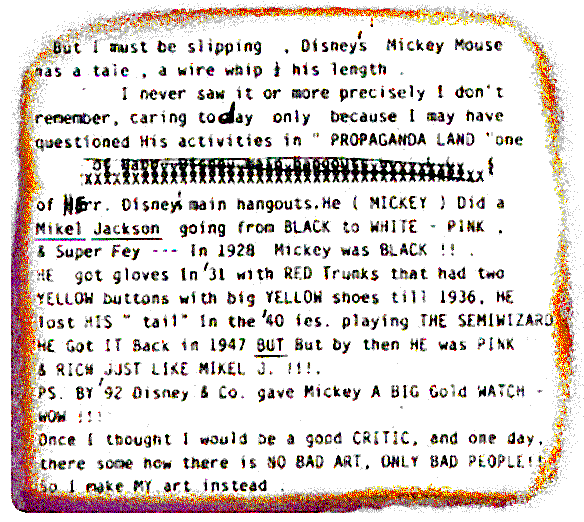
This Year 2001 is the Disney Centenary
Unflushing the Memory Hole
_________________________________________________

That is Utter Baloney Mr.4 H
companimen
________________________________________________
(Besides his obvious innate racism) this is the REAL reason for Bush's inordinate fear of China.
ALL THE BEST,LEE : ) http://www.e-insite.net/electronicnews/index.asp?layout=article&doc_id=40858&spacedesc=news
__________________________________________________
Loompanics.com/Articles/SatanSellers
___________________________________________________
www.whiteracist.com/nigger.html still off line
American Renaissance
Home On Victor Craig's "A Defense of the Faith" by Edwin Clark
Christianity Pro and Con
I thought this was a good piece, as good as an article arguing this position can be, but still not
quite good enough to be persuasive. Most of my problems with it come from its first page or so.
(1) Mr. Craig writes that Christianity "created the very culture that men of the West claim to defend."
To racialists, this is just not so. The race--the white gene pool--created the culture. The genes of
white people predispose their carriers to behave in certain ways, and eventually those ways of
behavior are shaped into institutions and those institutions constitute the culture, which then
reinforces and selects for the genetically based behavioral patterns. Moreover, white culture existed
long, long before Christianity appeared--among the ancient Indo-Europeans, the "barbarians" known
to the Greeks and Romans, and most obviously the Greeks and Romans themselves. What is
interesting is that white men took the rather measly contributions of the early Christians (the
Gospels, the letters of Paul, and various apologetic and polemical writings) and invested them with
classical philosophy, Greek and Roman legal and political institutional structures, Western art
forms, and even pagan religious usages (saints in place of gods, Christian festivals in place of
pagan ones, the portrayal of Christ as a European, etc.)
In other words, whites re-invented Christianity to reflect their innate preferences, and it is in that
form that Christianity shaped, "created," and pushed white European civilization. Revilo Oliver in his
Christianity and the Survival of the West makes the interesting point that Christianity survived only
among whites, that it died out in the Near East with the appearance of Islam and never took much
root in Asia or Africa. That is because by the time Islam appeared, Christianity had already been
re-invented as a European religion that exerted little appeal to non-Europeans. Subsequently it
flourished among non-Europeans only at the point of the sword. So I think Mr. Craig is wrong in his
basic premise that Christianity created the West; on the contrary, the West and its underlying
genetic substratum created Christianity. (Even ignoring the genetic factor, it is still clear that whites
had civilizations long before Christianity and that a very large part of post-Christian civilization
derives from it).
(2) Mr. Craig writes that "Christianity must therefore be rescued and revived." Two points here: (a)
why the "therefore"? Even if we concede that Christianity "created" the West, it doesn't necessarily
follow that the continuing survival of the West depends on the continuation or revival of Christianity.
By analogy, art may have first appeared as a means of propitiating the gods or the forces of nature,
but that doesn't mean we have to continue to believe that art can really do that in order to keep
producing art.
(b) How is it possible for traditional Christianity as Mr. Craig depicts it to be revived? I really don't
grasp this. Christianity has died or declined to its present state because of the effects of modern
science and historical scholarship; it's all very well for Christian intellectuals to concoct fancy
apologetics for Christianity, but the fact is that it is simply impossible for modern educated men to
believe in the Bible or the claims of the church to the degree necessary for the revival of traditional
Christianity.
At the time Christianity first appeared and for many centuries afterward, it was a plausible set of
beliefs because it shared with paganism a supernaturalist world view. Even highly educated men,
Christian or not and usually even non-religious people, readily believed in supernatural phenomena
and explanations--miracles, magical cures, curses, witchcraft, demonic possession, ghosts,
omens, various kinds of fortune telling, etc. They were as ready to invoke supernatural explanations
of natural phenomena they didn't understand as to invoke or look for naturalistic ones, and they
really did not have very convincing explanations of phenomena they knew were natural (magnetism,
thunder and lightning, earthquakes, etc.). Hence, it was not implausible to minds steeped in
supernaturalism to believe that a man could rise from the dead, that loaves and fishes could be
created from nothing, that a man could walk on water, that virgins could give birth, and that some
beings (gods, demigods, magicians) could work miracles.
Today, virtually no educated person and few uneducated ones believe in this kind of
supernaturalism. Some may suspend their normal naturalistic habits of mind to acknowledge belief
in biblical miracles, but almost no one believes that supernatural explanations are as plausible as
naturalistic ones. Since the 18th century, modern science has offered naturalistic explanations and
denied the existence of the supernatural so effectively that the modern mind has simply retreated
from and abandoned a supernaturalistic world view. Yet the restoration of just such a
supernaturalistc world view is what would be required for traditional Christianity to be revived as the
dominant creed of Western man. I do not say that it is not possible to be some kind of a Christian,
but it is not possible to be a traditional Christian if you are intellectually serious in the light of
modern science.
The only people in the last century who have been serious Christians have been either ignoramuses
(i.e., people who because of stupidity and ignorance or because of willful blindness have closed
their minds to the implications of science) or intellectuals (Kierkegaard, Dostoevski, T.S. Eliot, C.S.
Lewis, etc.), who are able to come up with extremely sophisticated defenses of it that most people
can't understand and which are usually intensely personal. That may be fine for intellectuals, but a
religion confined to them and the ignorati will not be traditional Christianity and cannot be a
culturally dominant force or an effective guide for most people. Given the blows suffered by
Christianity in the last 200 years or so, I see no alternative to the conclusion that the Christian cat
is out of the bag and can't be put back in as long as the forces that let him out are still in existence,
and personally I would take those forces (science and scholarship) over Christianity.
(3) I also don't see why "no student of history can argue that Christianity is somehow `inherently'
defective in ways that weaken the race." Liberal Christianity is by no means a product of the
post-1945 era; it goes back at least to the Renaissance and maybe to the origins of Christianity.
There are certainly passages in the New Testament that instruct us to practice an unmitigated
universalism, altruism, subordination of self-interest, and rejection of this world (power, wealth,
family, class, nation, race, self, etc.) I am the first to admit that these passages can be interpreted
in various ways, but repeatedly throughout Christian history they have been interpreted in "liberal"
ways. There is no way to settle what they "really" mean except through imposing your own
meaning, which is what the traditional church tried to do, ultimately unsuccessfully.
When racialists say that Christianity is "inherently" egalitarian, universalist, etc., they usually mean
that these passages are part of the Christian baggage train and can't be removed and sooner or
later will pop up. They are right; these passages and heresies based on them popped up throughout
antiquity and the Middle Ages. Ah, yes, but, says Mr. Craig, they were heresies, condemned by the
church, and can't fairly be ascribed to real or true Christianity. Yes, and the church did suppress
them, but they kept coming back and eventually triumphed.
I might also point out, especially with reference to Mr. Craig's statement that "what we now think of
as `liberalism' rose up as a force independent from and hostile to the Church," that "liberalism"
didn't just pop up out of nowhere. Liberalism is essentially a secularized version of Christianity that
takes its "liberal" branches and exaggerates them into the whole tree. I can grant that this was
done erroneously and fallaciously, but it still happened and was bound to happen once people
started mouthing off about "the meek shall inherit the Earth" and that sort of stuff. It is very clear
that only Christian civilization has ever spawned anything like liberalism. The Greeks and Romans
knew nothing of it, and their class struggles were simply that--conflicts between rich and poor for
class power--without any jabber about "rights," "equality," "peace," and "universal brotherhood." All
these latter blessings derive ultimately from Christianity.
(4) The fact that it took a long time for the "inherent" tendencies of Christianity to triumph is not a
persuasive argument that these tendencies aren't really there. It takes a long time for smoking to
cause cancer, but just because you smoke one cigarette and don't get cancer doesn't mean
smoking doesn't cause cancer. Most traditional Christians would argue that tendencies planted in
the Renaissance or Enlightenment blossomed into modern secularism and communism, but the
fact that it took a long time for them to so blossom isn't a problem. Moreover, as I mentioned above,
it didn't take so long after all, because the inherent tendencies of Christianity began to sprout even
in antiquity in various heresies; they were denounced and suppressed by other tendencies but
survived underground and resurfaced later.
(5) I also disagree with the idea that "our culture is so saturated with Christianity that the two simply
cannot be separated." The example given is that of Bach's B Minor Mass. Why not the Parthenon
or the Iliad? How can we truly appreciate classical architecture and literature unless we restore the
classical paganism that inspired them? The truth is that white men can appreciate white culture
regardless of the religion or philosophy behind it; that's why we as whites do appreciate the art of
the pagans or even that of non-whites, whom we persist in imagining as white people. Sharing a
religious or philosophical point of view might help us appreciate it, but I can't see that it is
necessary, and not sharing it might even help explain or illuminate the art and literature of pagan or
Christian cultures. Certainly the Christian artists of the Renaissance appreciated classical pagan art
and literature, despite their disagreements with pagan religious beliefs.
Finally, I think Mr. Craig and I could find common ground by agreeing that human beings, including
and perhaps especially whites, need some kind of myth of transcendence as a motivating and
justifying framework of action. Paganism provided that once, just as traditional Christianity did also
once, but today neither one can be revived or restored. What whites need now is a new myth of
transcendence that can offer transcendent, absolute validation for what they need to do to survive
and continue their civilization. Where they can get such a new myth I don't know.
~~~~~~~~~~~~~~~~~~~~~~~~~~
Subject:
Re: FYI Scientific American: Explore!: Sci/Tech Web Awards 2001: May 14, 2001
On Thu, 28 June 2001, Charles Mingus III
~~~~~~~~~~~~~~~~~~~~~~~~~~
Christoph wrote:
--------------------
PRESS RELEASE
UNIVERSITY OF CALIFORNIA AT SANTA CRUZ...
July 9, 2001
Contact: Jennifer McNulty (831) 459-2495; jmcnulty@cats.ucsc.edu
REPUBLICANS NEARLY THREE TIMES AS LIKELY AS DEMOCRATS TO HAVE
NIGHTMARES, SAYS RESEARCHER
International dream conference returns to UC Santa Cruz, July 10-15
FOR IMMEDIATE RELEASE
SANTA CRUZ, CA--The voting booth is not the only place differences
emerge between Republicans and Democrats, according to a researcher
who has found that Republicans are nearly three times as likely as
Democrats to experience nightmares when they dream.
Not only is the frequency of nightmares much higher among Republicans,
but the content is different, too: The nightmares of Republicans tend
to be characterized by more aggression, misfortune, and physical
threats to family and friends, while Democrats' nightmares are
moderated by familiar settings, familiar characters, and more elements
of hope, power, and positive action, said Kelly Bulkeley, a dream
researcher who will present his findings during the 18th Annual
International Conference of the Association for the Study of Dreams,
which takes place July 10-15 at the University of California, Santa
Cruz.
"Half of the dreams of Republicans in my study were classified as
nightmares, compared to only about 18 percent of the dreams of
Democrats," said Bulkeley. "My speculation is that people on the right
are very attuned to the dangers in the world, and they're seeking ways
to defend themselves against those threats. They're drawn to a
political ideology that favors things like a strong military and
traditional moral values. People on the left tend to be more utopian
and open to the possibility of going beyond the way things are now to
how things could be made better."
Bulkeley's presentation will take place on Wednesday, July 11, in
Oakes College, Room 105, from 9:15 to 10:45 a.m. It is one of more
than 100 events being featured during the conference, including
presentations by the world's foremost dream researchers, authors,
and clinicians.
Christoph
~~~~~~~~~~~~~~~~~~~~~~~~~~
2001 A DREAM ODYSSEY INTERNATIONAL DREAM
CONFERENCE JULY 11-15, 2001
ASSOCIATION FOR THE STUDY OF DREAMS (ASD)
Devils dictionary Redux
c = They eat insects that kill humans
o = A religious toy used annually
m = A common myth & coverup for ansestoral slavery as the genisis of
p = a religious object
a = Yet another beloved war tool
n = an utopian,fantasy
very taisty when batter fried
i = The ultimate tax
e = Proof of debt paid

John Sack-, AN EYE FOR AN EYE: THE UNTOLD STORY OF JEWISH REVENGE
AGAINST GERMANS IN 1945-,HarperCollins, Publishers.- Hardcover dj/ pub. 1993/ VG
condition/ 249 pages The Soviet Union, which occupied Poland and parts of Germany, a
region inhabited by ten million German Civilians, established the Office of State Security
and deliberately recruited survivors of the Holocaust to carry out a policy of de-Nazification
(A8473) $21.95
index