
1
|
 |
  |
blackmoney.com editor John William Templeton is a
popular speaker on investment, economics and history.
http://web.archive.org/web/*/http://blackmoney.com/
|
||
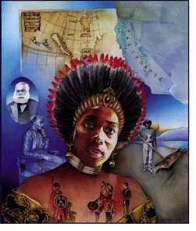
How California got its name.
In 1535, The Spaniard Hernan de Cortes sailed west
from the coast of New Spain (Mexico) in search of a
mythical island inhabited by strong, black women, and
rich with gold. The island, called "California" in an
account by Garcia Ordonez Montalvo in 1510, was
ruled by the queen "Califia."
Along with a company of 700 conquistadors, three
hundred of whom were of African descent, Cortes
landed at the southern tip of what we now know as
the Baja peninsula.
Spanish maps began calling this land "California"
and depicted it as an island for more than 150 years.
|
|||
African Americans Were
Among the Earliest
Californians
For the next 200 years, the Spanish pushed northward,
exploring, expanding their territory, and establishing
missions.
By 1769 the explorers reached what is now the state of
California and over the next 15 years created a series
of missions along the coast. Early census data show
that nearly half of the Spanish soldiers and the
pobladores (settlers) that accompanied them and
settled the mission lands were of African descent.
|
|||
Land Owners
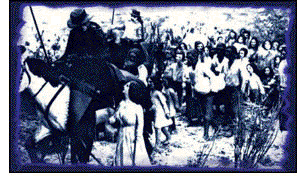 As seen in this picture of a diorama from the Los Angeles
County Museum of Natural History, 26 of the 46 pobladores
who settled Los Angeles, and similar proportions of the
founders of San Diego, Santa Barbara,San Jose, Monterey were of African ancestry.
Their descendants became holders of land grants
after the Mexican Revolution and the end of the mission
system.
Properties such as Rancho Rodeo de Aguas (Beverly Hills), Malibu, Venice, the current Camp Pendleton, the entire Orange County and the San Fernando Valley were held in those land grants.
By 1848 the more than two million acres throughout California held by Black grantees fell under threat as
more than 50,000gold seekers flowed into California
from the East.
|
|||
2
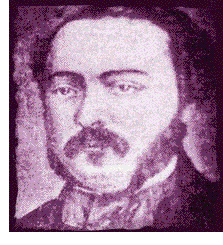   |
William Alexander Leidesdorff
Man Without Boundaries
Many early Californians of African heritage arrived
via the sea. An outstanding example was Capt. William
Alexander Leidesdorff, a native of the Virgin Islands
who moved to New Orleans as a wealthy cotton broker.
Leidesdorff sailed his ship to the Hawaiian Islands in
1838 and began making the trip from Hawaii to the
coast of California to trade with the mission at Yerba
Buena, bringing sugar from Hawaii and returning with
hides.
By 1841, the cosmopolitan Leidesdorff decided to
make the Bay area a real destination, building the City
Hotel and the first shipping warehouse. He aligned with
Emanuel Victoria "the black governor" of Alta California
and became a Mexican citizen. Victoria granted
Leidesdorff Rancho Rio de Americanos on the site of
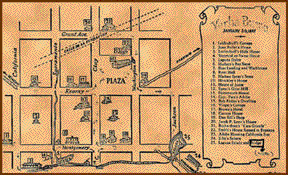
the current city of Folsom. Leidesdorff also bought 41
lots in Yerba Buena and built the largest house in the
city at the site of the current Bank of America tower.
After the overthrow of Victoria by Pio and Andres Pico,
Southern California's largest land barons, Leidesdorff
began advocating an American takeover of California
and became the U.S. vice consul in Alta California.
Leidesdorff was also the first black American diplomat.
 He wrote the report on the Bear Flag Revolt and drafted
the proclamation that declared California part of the
United States upon the landing of Commodore Stockton's
forces. In 1846, he became first city treasurer of San
Francisco, and served as alcalde (mayor) briefly.
Leidesdorff's most enduring legacy was the founding of
public education in California at a school in Portsmouth
Square in 1848.
|
3
 |
Blazing Trails
African Americans were among the first explorers to
forge land routes -- still unknown as late as the 1830's --
to California from the East.
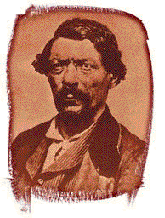
James P. Beckwourth, an escaped slave, became a
renowned "mountain man." Beckwourth had extensive ties
with indigenous peoples across the continent and was an
honorary chief of the Crow Nation. With Native American
help, Beckwourth was able to find the low pass through the
forbidding Sierra Nevada range that opened California to
large-scale migration from the east.
As the Mexican War began, Beckwourth left the camp of then-
Governor Pio Pico, rustled hundreds of horses and headed
east to join the U.S. Army as its scout throughout California.
He also was a Pony Express rider for a time. During the Gold
Rush, he established a general store to supply the stream of
incoming settlers. His name is remembered with the town of
Beckwourth, Beckwourth Peak and Beckwourth Pass near
the California-Nevada border along U.S. 50 to Lake Tahoe
and Reno.
Another African-American Jacob Dodson, accompanied Lt.
John Fremont, who launched a scientific mapping expedition
that reached the Pacific Ocean in 1846.
|
 |
Jazz Tracks
 Among the products of the new wealth generated by the discovery of gold in California was the building the transcontinental railroad.
The labor of thousands of Chinese and African-American workers laid those strips of steel across the continent.
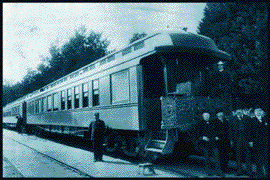
By custom, porters aboard the transcontinental rail cars
were required to be African-Americans. Many of these porters
settled at the western terminuses of the lines in Oakland and Los Angeles, creating community institutions and also encouraging relatives to move West.
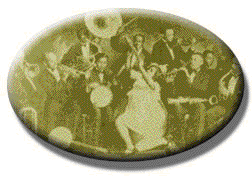 Two of those porters, Sam King and Lew Purcell, built what
was apparently the site of the first "jazz" club anywhere as early as 1901 on Pacific Avenue in San Francisco near the port area.
|
4
       |
Black Achievers
From soldier to seafarer, cowboy to commissioner, significant
African-Americans in California history are found throughout the
state's varied natural environments.
Allen B. Light of San Diego was the commisario general in 1831,
in charge of the otter trade, California's main export before the
Gold Rush.
Lt. Charles Young, the third black graduate of West Point, was superintendent of Sequoia National Park in 1903. The Buffalo
Soldiers of the 9th and 10th Cavalry, headquartered for a time
at the Presidio in San Francisco, patrolled Yosemite National
Park, Sequoia and Grand Teton beginning that year before the
creation of the National Park Service.
Jesse Stahl of Salinas was the holder of the world record as
the best rodeo cowboy in the early 1900s.
 Lonnie Clayton and other black jockeys at the Oakland Jockey
Club won the Kentucky Derby and other races in the 1890s.
Capt. Michael Healy commanded a U.S. Coast Guard cutter from
Oakland that was the only official representative of the U.S.
Government in Alaska after its purchase in 1867. He was in effect,
that territory?s military governor for several years.
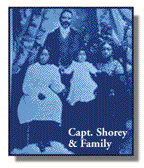
Capt. William Shorey, who also sailed from the port of Oakland,
commanded the last whaling ship on the Pacific Coast, escaping
peril on numerous voyages as late as 1901. His nickname was
"Black Ahab" from the Herman Melville novel "Moby Dick" Once
oil was discovered, the demand for whale products rapidly
declined.
In current times, Donald Wayne Murphy rose from being a park
ranger to director of the California Department of Parks and
Recreation.
Frederick E. Jordan has completed more than 1000 transportation
projects, including the rebuilding of the Cypress Structure as
founder of California's first black-owned civil engineering firm,
celebrating its 30th anniversary in January 1999 and Harlan Kelly
Jr., San Francisco's city engineer, supervises such projects as the
renovation of the City Hall and building of the new emergency
communications center.
Any of them will tell you that a thorough
knowledge of science and mathematics
allows you to interact with your environment
and not have your environment control you.
 You can make a mark on California just like they have.
|
||||
Caley
$13 billion = 7 Million You decide you do the math.
Slavery Research slavery at the world's largest online library.www.questia.com
|
|||||
|
|
|||||
5
|
 |
|||
 |
Early Metallurgist
|
|||
Among the African-Americans taking part in the gold rush migration was
Moses Rodgers, who gained a reputation as the best scientific researcher
on how to discover and test gold, and operate gold mining operations.
He operated a mine at Temecula and settled in Stockton. As a result of
his initiatives, the first gas line in Stockton was created, and his daughters
were the first black women to attend the University of California at Berkeley.
Hundreds of blacks participated in gold mining. The 1855 Colored
Convention in Sacramento reported a census that showed that fewer than
2,000 blacks in the state at the time had assets of more than $3 million.
Maps help to point out where they were with names such as Negro Bar
and Negro Camp. Some of those sites are recognized as state historic
landmarks. Inside this case, you will find tools that professionals like
Rodgers used to determine the gold content of rocks by using chemical
properties such as the affinity of gold to bond with either mercury or cyanide.
He also had to be proficient with measurement tools such as scales.
|
||||
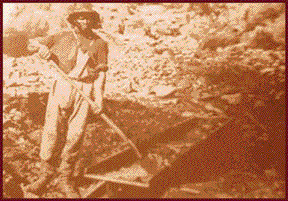 |
African American
miner at the
Auburn Ravine.
|
|||
| 6 |
|
|
 |
blackmoney.com editor John William Templeton is a popular
speaker on investment, economics and history.
http://web.archive.org/web/*/http://blackmoney.com/
John William Templeton President, Executive Editor, Electron Access Inc.
630 20th St. Suite 109 Oakland, CA 94612
510-663-2649 fax 510-465-1330
email: askiatek@blackmoney.com
|
|
Credits
The exhibit panels for African American Heritage Month at the California
Academy of Sciences were developed by John William Templeton. Since
1991, Templeton has compiled and published four volumes of the anthology
Our Roots Run Deep: the Black Experience in California, along with the
fourth-grade reader Overlooked Overachievers: Blacks in California History,
the Our Roots Run Deep Activities Workbook , two documentaries-- Our
Roots Run Deep and Leidesdorff: A Man Without Boundaries-- and photo
exhibitions at the San Francisco Main Library, Los Angeles Central Library,
State Capitol Museum and Tech Museum of Innovation. He is an honors
graduate of Howard University with further graduate study at the University
of North Carolina-Chapel Hill and professional studies at Stanford University\
and University of California, Santa Cruz.
The layout and design for this project was created by Bay Area graphic
artist Brian Bouldin. Born and raised in Oakland, Brian has worked on
various community projects, including teaching art to grade school children,
and was the exclusive graphic artist for the 1998 Oakland Black Expo.
Additional samples of his work can be seen at his web site,
Other Credits: Los Angeles County Museum of Natural History (diorama),
San Francisco African-American Historical and Cultural Society
(Leidesdorff), Museum of San Francisco (map of Yerba Buena), Bancroft
Library, University of California, Berkeley (Beckwourth, porters, gold miners,
Capt. Shorey), San Francisco Room, San Francisco Public Library (Sid
LeProtti Jazz Orchestra), California Dept. of Parks and Recreation
(Allensworth), San Francisco Department of Public Works, F.E. Jordan
Associates, California State Library, UCLA Special Collections, ASPIRE
Books, San Jose Public Library, Professor Sylvia Wynter (ret.), Stanford
University Department of Spanish and Portuguese; Dr. Jack Forbes, Center
for Native American Studies, U.C.-Davis, Dr. Margo Hendricks, Dept. of
Medieval Literature, U.C.-Santa Cruz, Dr.! Rudolph Lapp, (ret.) College of
San Mateo, Lynn Ludlow, San Francisco Examiner, Ray Taliaferro, KGO-AM.
|
||
blackmoney.com editor John William Templeton is a popular
speaker on investment, economics and history.
http://web.archive.org/web/*/http://blackmoney.com/
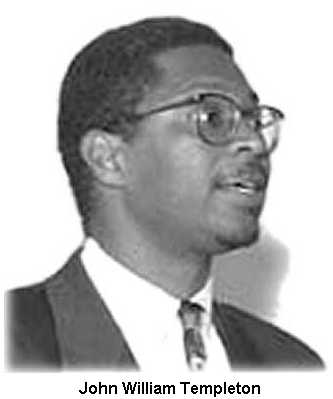 John William Templeton President, Executive Editor,
Electron Access Inc. 630 20th St. Suite 109 Oakland,
CA 94612 510-663-2649 fax 510-465-1330
email: askiatek@blackmoney.com
BerkeleyLab http://www.lbl.gov/
Berkeley Lab Highlights 2002-2003 http://www.lbl.gov/Science-Articles/Research-Review/Highlights/2002/index.html
|
||
|
 |
|
could allow the collection to move to a new museum more conveniently located in downtown Philadelphia.
This proposal has Queen Califia's Magical Circle
Queen Califia's Magical Circle, the only American sculpturegarden by French artist Niki de Saint Phalle, opened in Escondido, CA, Oct. 26, 2003.
African Ancestry in California
HISTORY & BACKGROUND
The Naming of California
The state of California was named for Califia, reputedly a Black virgin queen. She was said to rule an "island nation"
of Amazons, where gold was the only metal. Even as late as 1707, some European maps continued to depict
California as an island. While many California children hear the story in school of the origin of our State’s name,
not many are made aware that she was said to be Black. See More about Queen Califia.
Were there Blacks in California at such an early date? Could Queen Califia's legend possibly bear seeds of truth
regarding her racial identity? Indeed there is a long history of Africans having arrived on American shores at very
early dates, and of Spanish ancestry sometimes having been mixed with Black.
Spanish California (Northern New Spain) - Before 1821
Racially mixed Spaniards became somewhat common as early as 800 A.D. with the conquest of Spain by the
Muslims, who then ruled there for 500 years. There was further mixing during Spain's long period of trade with
Carthage and Morocco. African sailors were also members of the Spanish expeditions which came to parts of
North America, including Mexico, where a fair number of them stayed and became permanent residents in the
1500s. Further, there are a number of Native American legends, which often appear to be historically accurate,
concerning the arrival of early Blacks, some of whom were shipwrecked sailors.
Many Afro-Spaniards were fully integrated into their societies, while others were slaves. Those in Mexico played a
huge role in helping to expand the frontier areas northward from Old Mexico. At that time "New Spain" consisted of
today's Mexico and the lands now occupied by Texas, Arizona, New Mexico, California and other parts of the
southwestern United States. It has been estimated by several respected historians that by 1790, one of every four
Spanish speakers in Lower California (now the country of Mexico) had some degree of Black ancestry, and a Spanish
census of that time actually identified 18% of the California population as being of African descent. See
Before 1821, European-born Spaniards held the most power in California, followed next by American-born Spaniards,
and then by light-skinned mixed bloods. Few African Americans attained high rank in the army, but they could often
rise to influential positions in civilian life. Many were in positions as supervisors at the Missions, and a number of them
were granted choice tracts of land called Ranchos. Mexico’s independence from Spain, won in 1821, helped mixed-
bloods obtain more (and larger) land grants, and to attain higher military rank and wealth. Slavery was abolished in
Mexico in 1829.
The Missions, Presidios and Pueblos
In the 1700s, many frontier soldiers and settlers were Afro-Mexican, and groups of these were integral to the founding
of the ~stephan/anthony/missions.html"California Missions (where Natives were to be “civilized”), the military
Presidios (to guard the Missions and settlers), and the Pueblos (the farming communities which became our cities).
For descriptive information on each Mission, see Mission Sites.
The Mexican Republic of California -- 1821-1846
By 1821, when Mexico became independent of Spain, the colonists of Upper California had learned to trade and co-
exist with trappers, sailors, traders, explorers, and hunters from other countries. Because Spain had been involved in
a number of wars, the Spanish fleet had often been unable to spare ships to bring supplies to them. The colonists had
turned to trade with England, France, Russia and the United States. Regular trade was carried on with St. Louis
through the Santa Fe Trail, and hides from Spanish cattle (which later became known as “California greenbacks”)
were being supplied to Boston shoe manufacturers by sea.
Once the new Mexican government took over Upper California, life there began to change dramatically. The Spanish
government had already begun issuing land grants for Ranchos in 1786, but these were few, under tight control, and
the land had remained the property of the Crown. Only the "use" of the land had been granted. Once the area became the
Mexican Republic, however, hundreds of huge Rancho land grants were made, which included ownership of the land itself.
Jealous of the amount of lands controlled by the priests, the Republic abolished the Mission system in 1834. Many of the
churches fell into disrepair, but have been restored and can be visited. Within 12 years after the secularization of the
Missions, over 700 Rancho land grants were made, many to white Californians, who were required to become nominal
Catholics and citizens of Mexico, and who often married into prominent Mexican families. Others were granted to new immigrants from Mexico who already had position, money and connections. While originally intended to encourage
agriculture and industry, reward soldiers, and provide for settlers who had no land, the land grant system rapidly
deteriorated into one of favoritism. The Mission Indians (who had been well trained as Spanish peons by then), became
Rancho workers to survive.
Since paperwork was not always in order by American standards, however, many of these land grants were not recognized
by the Land Commission set up in 1851 after U.S. Statehood was granted. In fact, some remain "unconfirmed" to this day.
Ranchos and Adobes
Anyone can tour the Missions and Presidios, or visit the greatly expanded cities which the Pueblos eventually became.
Even many Californians, however, are unaware of the giant Ranchos, which have become incorporated and annexed as
parts of cities throughout California. While their borders of the Ranchos are seldom evident, some cities bear their names.
A large number of the beautiful old Adobe houses (made from mud) are also still in existence. While some can not be visited
(and may only be viewed from the street), others do offer tours and sometimes have small museums connected to them.
A few are currently used as the homes of Historical Societies.
California Becomes a State -- 1846-1850
Statehood for California became inevitable after the 1836 revolt of Texas and its declaration of independence from Mexico.
When Texas was finally annexed to the United States in 1845, the U.S. unsuccessfully attempted to negotiate the purchase
of New Mexico and California. By then the Mexican government had become suspicious of American encroachment into
Upper California by troops and surveyors. Finally, in 1846 there was an uprising in which a group of Americans created their
own flag with a grizzly bear, and claimed their locality to be independent of Mexico. Shortly afterwards the U.S. declared
war on Mexico, and by 1847 had occupied Mexico City. Andres Pico, a Black-Mexican, met with Major John Fremont as
the representative from California to discuss the terms of surrender. A military officer, this famous Pico brother is best
known for having defeated Gen. Stephen Watts Kearney at the Battle of Pascual. The Treaty of Guadalupe Hidalgo was
signed in February 1848, and Mexico ceded all its territories in the Southwest to the United States, including Upper
California.
The wheels of government turned slowly, however, with considerable discussion as to whether the form of government in
California should be that of a Territory or a State. Meanwhile, gold was discovered at Sutter’s Fort! Local residents grew
tired of waiting, drew up a state constitution making California a "free" state excluding slavery, and chose state officials
in 1849. Finally, the Bill giving Statehood to California was signed in February 1850.
The Gold Rush Era - - 1848-1860
Gold Rush Country is considered to cover 300-400 miles along the California side of the Sierra Nevada, mainly along what
is now Highway 49. It has been estimated by the California Division of Mines and Geology that at least 500 towns were
established there between 1848 and 1860. Most have disappeared, but some towns were able to adapt to 20th Century
changes, and their people found reasons to stay after the gold had played out. Some locations now consist only of a
historical marker erected by various Chambers of Commerce, the California Division of Highways, local historical
societies, and the like. Many maps are available for tourists who wish to visit the ghost towns, and several of the towns
that lasted and thrived have tours and hold commemorative events.
In 1849 alone, at least 41,000 people arrived by sea for the Gold Rush. By mid-summer, 400 deserted ships sat in San
Francisco Bay. Some Forty-Niners had sailed from the East coast around the Cape of Good Horn; some had chosen a
much harder shortcut through the jungles of Panama, where the canal had not yet been built. Others came by land in
wagon trains, and even on foot. Numerous countries were represented by immigrants from China, Europe, South America
and several Pacific Island nations. Blacks also came to California, as servants, slaves and free men, alone and in groups,
to work in various capacities.
There are numerous books available about the Gold Rush; most barely mention Black Mining Camps and even fewer tell
of Black Miners. We know they were there, because the foreign press of the time often published engravings of them, and
there are also some photographs of them in print in America. Their presence is also mentioned in a number of diaries and
letters found in special collections. Rudolph Lapp has done a tremendous service with his book entitled Blacks in Gold
Rush California.
Discrimination in California - 1846 – the early 1900s
Many white Americans brought their prejudices with them from their old homes when they came to California.
Laws and policies similar to those “back home”, such as lack of equal education, disenfranchisement and the inability
to testify in court were enacted and carried out, and discrimination often ran high. While not allowed to serve in the military
in California in the very early years, African-American military men and their units have belatedly been recognized at several
U.S. National Historic Parks in California as having guarded and worked in the areas in later years where these parks are located.
Although the African-American population was never large by comparison, that did not keep them from
fighting against second-class citizenship, or from creating social, cultural and political structures for themselves. Because
of discrimination, they formed their own churches, newspapers, literary societies, libraries, relief agencies, social clubs,
fraternal groups, political organizations, women’s clubs and civil rights organizations.
|
Wednesday, April 10, 2002
|
a foreign policy doctrine that was enshrined and sustained by the
legacy of the Holocaust,is beginning to crack with the country quietly
suspending weapons sales to Israel and leading politicians, led by
conservatives, employing strikingly harsh language to criticize Israeli
military action in the West Bank policy adviser to Prime Ministe Ariel
Sharon of Israel, that were described as "cool."
"In a widely publicized letter to Israel's ambassador to Germany, Norbert Bluem, a former labor minister under Chancellor Helmut Kohl, described the Israeli offensive
as a "war of annihilation" - the very term employed by
Adolf Hitler to describe the 1941 invasion of the Soviet
Union."
|
(1 of 2) [1/24/2004 1:40:44 AM]
>
>Lee Says If you haven't seen this,
>you might care to scan it. http://www.bushin30seconds.org/
>FYI
>Re: FYI from C. to cmu
>this will happen before Israel goes under."
> "ok with me", cmunc "I can assure you that that .
>On Sat, 10 Jan 2004 03:48:07 -0500
><><><@> writes:
>
>Islamic Association for Palestine (IAP)
>Israeli Professor - 'We Could
>Destroy All European Capitals'
>By Nadim Ladki
>2-6-3
>
>
>(IAP News) -- An Israeli professor and military historian hinted that
>Israel could avenge the holocaust by annihilating millions of
>Germans and other Europeans.
>
>Speaking during an interview which was published in Jerusalem Friday,
>Professor Martin Van Crevel said Israel had the capability of hitting
>most European capitals with nuclear weapons.
>
>"We possess several hundred atomic warheads and rockets and can
>launch them at targets in all directions, perhaps even at Rome.
> Most European capitals are targets of our air force."
>
>Creveld, a professor of military history at the Hebrew University in
>Jerusalem, pointed out that "collective deportation" was Israel's only
>meaningful strategy towards the Palestinian people.
>
>"The Palestinians should all be deported. The people who strive for this
>(the Israeli government) are waiting only for the right man and the right
>time. Two years ago, only 7 or 8 per cent of Israelis were of the opinion
>that this would be the best solution, two months ago it was 33 per cent,
>and now, according to a Gallup poll, the figure is 44 percent."
>
>Creveld said he was sure that Israeli Prime Minister Ariel Sharon wanted
>to deport the Palestinians.
>
>"I think it's quite possible that he wants to do that. He wants to
>escalate the conflict. He knows that nothing else we do will succeed."
>
>Asked if he was worried about Israel becoming a rogue state if it carried
>out a genocidal deportation against Palestinians, Creveld quoted former
>Israeli Defense Minister Moshe Dayan who said "Israel must be like a mad
>dog, too dangerous to bother."
>
>Creveld argued that Israel wouldn't care much about becoming a rogue
>state.
>
>"Our armed forces are not the thirtieth strongest in the world, but
>rather the second or third. We have the capability to take the
>world down
with us. And I can assure you that that this will happen before Israel
>goes under."
>
>Islamic Association for Palestine (IAP)
>
Israel buying 3 submarines to carry nuclear
missiles... The London-based Jane's also
estimated "that the Israeli arsenal may
contain as many as 400 nuclear weapons
with a total combined yield of 50 megatons.
" The ...

Posted on Wed, Jan. 14, 2004 Palestinian mother kills 4 Israelis in Gaza Strip suicide attack.
By Soraya Sarhaddi Nelson Knight Ridder Newspapers
|
Suicide bomber, 22-year-old Reem Raiyashi, holding an
automatic rifle, reads a statement, aired on Israel TV. Flash
90, KRT.
 |
EREZ CROSSING, Gaza Strip - A Palestinian mother of two blew herself up Wednesday morning at the main crossing between Israel and the Gaza Strip, killing four Israelis - three of them soldiers - and wounding seven people. Four of the wounded were Palestinians.
The suicide bombing marked two firsts: the first time the Islamic militant group Hamas sent a female bomber and the first time a mother was a suicide bomber. Reem Raiyshi, 22, left behind two children, ages 1 and 3.
At a vigil for her in Gaza City, militant men defended sending a mother for the job. Palestinian women abhorred the idea that a woman would abandon two young children.
In the end, Raiyshi was reduced to the contents of three white trash bags, carried through the checkpoint at night and destined for a raucous Gazan funeral likely to take place Thursday.
The attack occurred at 9:30 a.m. at this hub for thousands of Palestinian laborers, who pass through a network of barbed wire fences, concrete barricades and security checks every day to go to highly coveted jobs in Israel. Most earn less than $25 a day, but that's far more than they can make at home, said tailor Ashur Solha, 40, a father of eight.
There were few laborers Wednesday in the vicinity of the one-story structure Raiyshi demolished with her TNT and nail-laden bomb belt, as most of them already had crossed.
Brig. Gen. Gadi Shamni, who heads the Israeli military division in Gaza, said Raiyshi entered the checkpoint at the Erez industrial compound with about 20 Palestinians. She said she'd come to seek a permit to enter Israel, and lied to soldiers that she had a titanium implant in her leg that would set off the metal detector. After the detector sounded, she was ushered to a room for a more thorough security search. The room was a humanitarian gesture to assure her privacy, he added.
"This incident shows that terrorists will do anything to damage any kind of cooperation between Israelis and Palestinians," Shamni said.
Hours after the explosion, Israeli army medics wearing rubber gloves carefully sifted through broken ceiling tiles covering the floor, searching for human remains. Outside, a dozen soldiers guarded thousands of Palestinian workers on a muddy field awaiting bus transport back to Gaza. The men filed past with their shirts lifted to show they weren't carrying any bombs.
The military wing of Hamas and the al Aqsa Martyrs' Brigades, a Palestinian militant group affiliated with Palestinian leader Yasser Arafat's Fatah political movement, claimed joint responsibility for the bombing, which they said was to avenge Palestinians killed by the Israeli military, and vowed to escalate their attacks.
"This is of course the first time that the (military wing of Hamas) has conducted an action with a female and not a male fighter," the group's spiritual leader, Sheik Ahmed Yassin, said in an interview broadcast on Israeli television Wednesday night. "Of course we are talking about a new level, a new development, a new way to oppose the Israeli enemy."
Israeli security officials, meanwhile, discussed renewing their recently dormant campaign to assassinate Palestinian militant leaders, Israeli TV reported.
"Palestinian terrorists are not only intent on striking Israelis at every opportunity but they are also bent on destroying the Palestinian economy," said David Baker, an official in Israeli Prime Minister Ariel Sharon's office.
The Palestinian foreign minister, Nabil Shaath, was quoted on Israel Radio as saying his government was capable of stopping such attacks but wouldn't until Israel halted its attacks on Palestinians.
Although using a female bomber was new for Hamas, Islamic law allows it, said Ghazi Hamad, the editor of the Gaza City newspaper al Risaleh, which is closely associated with the militant group.
"There is a fatwa, or law, which allows all people, women and men, to participate in a war against an enemy if your land is stolen by the enemy," Hamad said. Using a woman in this case was a way to evade tight security at Erez.
Al Aqsa's female fighters spent 60 days training Raiyshi because Hamas was uncomfortable having men train a woman, said Abu Jandal, a spokesman for the group. They sent her past the first checkpoint at Erez seven times to see if she could pass without suspicion, which she did, he claimed.
A videotape Raiyshi left behind showed her smiling as she held the Muslim holy book, the Quran, in one hand and an assault rifle in the other. She professed love for her son, age 3, and daughter, 18 months, before an attack that she said was meant to turn her body into "deadly shrapnel."
"How long I've dreamed of conducting an attack in Israel, but didn't succeed," she said, donning a green Hamas headband over her Islamic head scarf. "How long I've dreamed of returning my soul to my maker. I always hoped to be the first female suicide bomber with the knowledge that my body will go to heaven. That is my wish to Allah, blessed be he."
In Gaza City, men and women milling near the mourning tent Hamas erected in Raiyshi's neighborhood reflected on her actions. Men praised her. "I would have no problem if my wife did this, especially because it's prescribed by God," said Abu Marwan, 39.
Women expressed outrage.
"It's very wrong, wrong, wrong," said Reem al Dahdou, 30, who cradled a 2-month-old daughter as she, her friend and their dozen children headed home. "As a woman, I can do what she does, I can help my people, but in a different way, by raising my children and teaching them to love their land. What do her children have now? Nothing."
Three miles away, under the watchful eyes of armed Israeli soldiers, three Palestinian ambulance workers in reflective vests each carried a bag of Raiyshi's remains through a metal detector and into the Gazan night.
---
(Special correspondent Cliff Churgin contributed to this report from Ashkelon, Israel.)
|